Kirsty Coventry Wants To Be The IOC’s First Female President. Insiders Think She Has A Good Shot
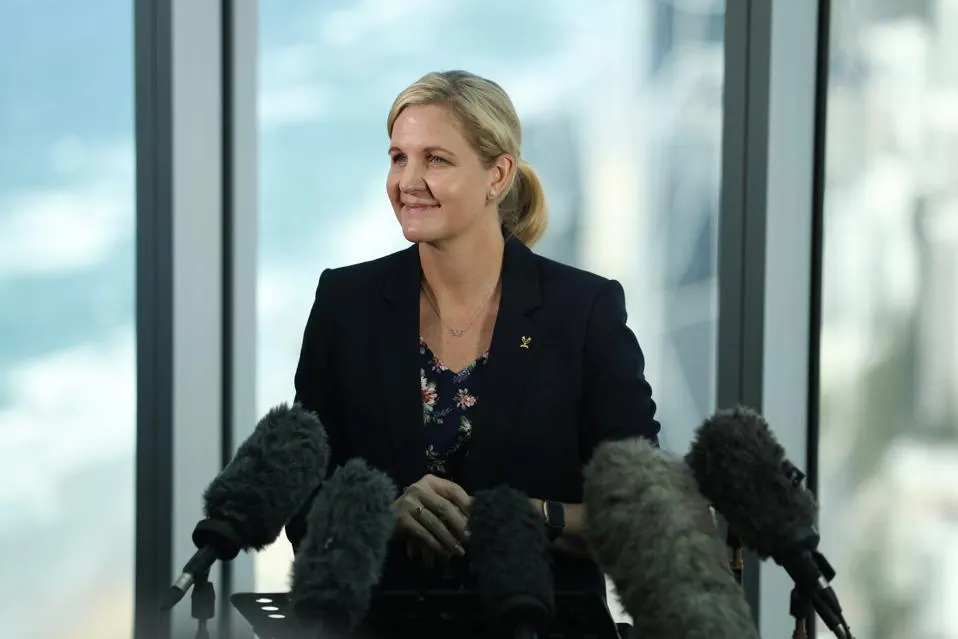
As the first African to run for the International Olympic Committee in an election considered too close to call as it enters its final hours, Kirsty Coventry has made waves in Olympic politics, albeit in a different way than she did in the pool for Auburn and Zimbabwe.
The rumor has been floated that Coventry, who participated at every Olympic Games between 2004 and 2016 and with seven medals is Africa’s most successful Olympic athlete, has outgoing IOC President Thomas Bach’s seal of approval. Not officially, of course: in keeping with the underlying mission of the IOC, Bach would never do something as openly partisan as endorsing a successor.
Still, suspicions persist — so much so that when Coventry presented herself before members of the media for a brief Q and A at the end of January the first question was whether she had Bach’s support, even in a behind-the-scenes kind of way.
“We all have a very good relationship with him and I think he is being very fair to all of us,” Coventry responded diplomatically, adding that she did not believe Bach would even vote in the March 20 election that will choose his successor. “I do very firmly believe he is being very fair to all candidates,” she said.
What Coventry and Bach share is an athlete’s philosophy. Both are Olympic champions: Bach won fencing gold with his German teammates in 1976; Coventry amassed two gold, four silver and one bronze in Athens in 2004 and Beijing 2008. (Sebastian Coe, another candidate, won two Olympic golds for Great Britain as a middle-distance runner in 1980 and 1984.)
As a candidate for IOC President, Coventry, who has been regarded as one of the frontrunners for the job along with Coe and Samaranch, is better positioned than most to appreciate the power of the Olympics and its intersection with politics. When she returned to Zimbabwe after Athens having won its only three medals — its second, third, and fourth Olympic medals ever — the country was in the throes of an “official hate campaign” against white citizens, who were being accused of funding opposition to President Robert Mugabe’s regime.
Yet when Coventry, who is white, appeared at the airport in Harare after winning a medal of each color in Athens, she was greeted as a national heroine, with tribal dancers beating drums and the head of Zimbabwe’s Olympic Committee succumbing to “tears of joy” at her accomplishments.
That was even better than being on the podium. “When I got home it was a time of three days or four days of peace, and so I really got to see the power of sport,” she recalled. “It wasn’t just understanding how powerful and how transformative sport can be, but I’ve actually seen it and I’ve walked in it, and I want to continue doing that.”
This ambition has led Coventry, who since 2017 has been Minister of Sport, Art and Recreation in Zimbabwe, to her historic bid for the Presidency of an organization that before 1981 did not have any female members. It took most of another decade before one was elected to the IOC Executive Board.
Coventry is one of only three IOC Presidential candidates to be an IOC member in her own right. (Only IOC members are allowed to stand for the Presidency.) Four others — Sebastian Coe of Great Britain, David Lappartient of France, Johan Eliasch of Great Britain, and Morinari Watanabe of Japan — hold IOC membership as Presidents of respective international sports federations. Their IOC memberships are due to expire either when they reach the age of 70 or as soon as they no longer head their federations.
At 41, Coventry is the youngest candidate by a decade, and the one most likely to be in tune with Generation Z, whose attention and favor the IOC openly covets. As a nine-year-old glued to the TV during the Barcelona 1992 Olympics, Coventry was enchanted by the power and glory of the Games, which culminated in her “setting myself a dream” to one day compete there.
Today’s nine-year-old isn’t watching TV; they are holding a phone, she noted. One of her few concrete proposals involves developing applications that will allow budding athletes to train no matter where they happen to be born or growing up, something that has hampered potential Olympians around the globe.
In a Q and A with reporters at the end of January, Coventry was the only candidate to face questions from the media about balancing being a parent and IOC President at the same time.
“I had to quickly learn how to navigate and be a woman with a career as well as a mum and a wife and everything else, and it can be done. I’m very lucky to come from Africa, because culturally we know and we firmly believe that it takes a village to raise a child, so I have incredible support that will continue in this leadership role,” she responded. Coventry was pregnant with her first daughter when she took up her ministerial role seven years ago.
Being the female president of a highly visible sports organization that has always coalesced around male leaders would be a novelty — and perhaps an attribute — but Coventry does not wish to be judged simply on her gender. Asked this week if it was time the IOC had a female president, she responded, “Well, I’m biased, so I’m going to say yes.”
“Female leaders do bring different attributes, lessons learned and soft skills to the table — but I don’t want it to be the only thing that people focus on. I want to be the best person that people and members see leading our organisation, not a choice just based on gender,” she told The Athletic.
Her agenda, perhaps less fleshed out than some of the other candidates, is nevertheless firmly centered around the athlete and what the IOC can do to make sure he or she thrives. Coventry has stopped short of saying that the IOC should award prize money to athletes (unlike Coe, under whose stewardship World Athletics gave $50,000 to each of the 48 Olympic gold medalists in track and field in Paris last summer), but she has professed herself open to ideas.
“We need to find more ways of directly impacting and getting revenue to athletes before they become Olympians,” she said. It’s one thing that she would focus on as IOC President. “That is generally the toughest [thing] most athletes find…in my journey it was easy to get sponsorship once I’d won a medal. It was getting to that medal that was tough.”